Atmospheric Conditions Refine Betting Markets for Field Football and Grass Track Racing
Sam Peters · Aug 14, 2026

Atmospheric Conditions Refine Betting Markets for Field Football and Grass Track Racing
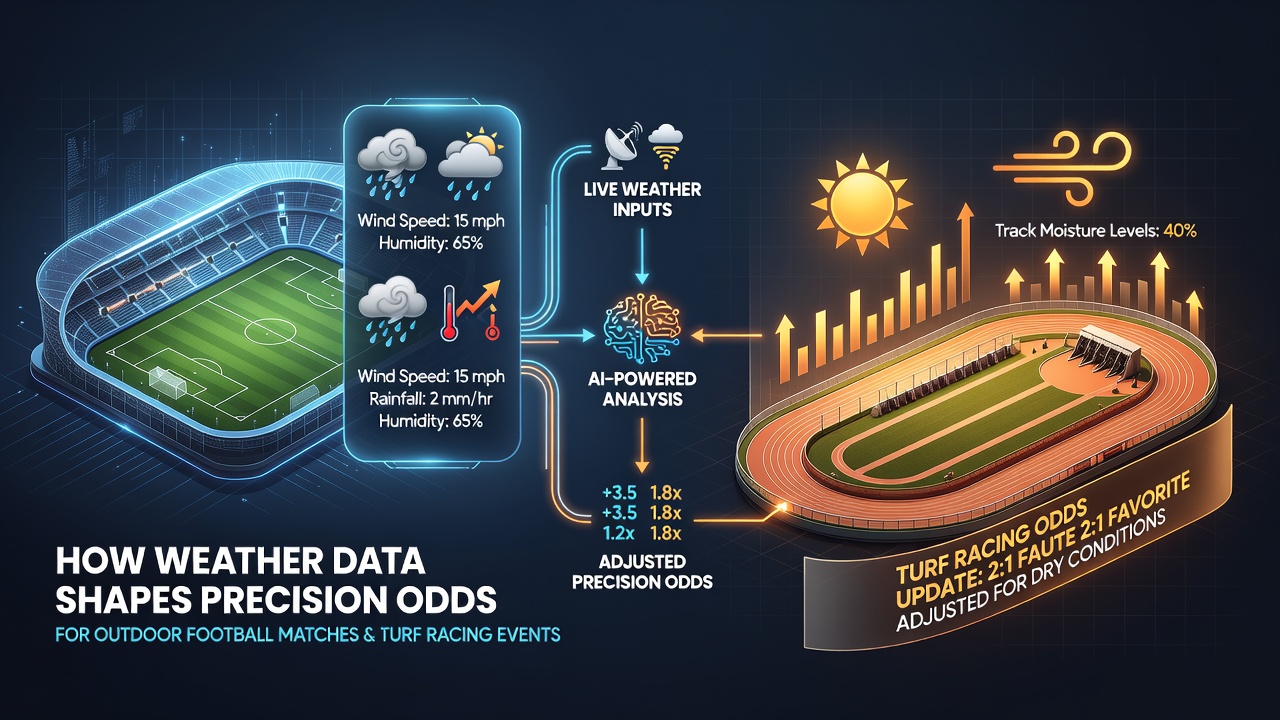
Weather analytics now integrate directly into odds models that bookmakers apply to outdoor football matches and turf racing events, with data streams from satellites, ground sensors, and numerical forecasting systems feeding real-time adjustments. Researchers at institutions such as the European Centre for Medium-Range Weather Forecasts have documented how precipitation totals, wind vectors, and temperature gradients alter pitch friction coefficients and equine stride lengths, producing measurable shifts in expected scoring margins and finishing times.
Football leagues that schedule fixtures across variable climates record consistent correlations between rainfall accumulation and reduced goal tallies, while turf racing tracks show speed ratings that drop sharply once soil moisture exceeds specific thresholds. Data from multiple seasons indicate that a sustained 15 km/h crosswind can reduce effective passing accuracy by several percentage points in open stadiums, prompting oddsmakers to widen handicap lines accordingly.
Forecast Integration in Market Construction
Operators compile ensemble forecasts that combine multiple model runs to generate probability distributions for key variables such as total rainfall during match windows or dew point levels at post time. These distributions feed proprietary algorithms that recalibrate totals markets and individual player props before lines are released to the public. Observers note that early-week projections often tighten or expand by several points once 48-hour forecasts arrive, reflecting updated precipitation likelihoods.
Track superintendents at major racing venues supply daily moisture readings and grass height measurements that feed into the same data pipelines, allowing bookmakers to adjust place and show probabilities with greater granularity. One study released by the American Meteorological Society examined 200 turf events and identified that a 5 mm increase in overnight rainfall correlated with average speed reductions of 0.8 seconds per furlong on certain surfaces.
Regional Climate Patterns and Seasonal Adjustments
August 2026 fixtures across European and North American venues illustrate how seasonal humidity spikes and late-summer thunderstorms alter pre-match expectations. Forecasters from Environment Canada and the Australian Bureau of Meteorology supply localized nowcasts that operators incorporate when setting opening totals for matches played in variable wind regimes. These inputs help distinguish between venues where drainage systems mitigate rainfall effects and those where standing water persists long enough to suppress offensive output.
Historical datasets reveal that matches contested in temperatures above 28 °C produce elevated substitution rates and altered possession metrics, prompting subtle line movements in player performance markets. Turf racing events scheduled during similar heat periods show increased incidence of slower overall times, with analysts documenting corresponding adjustments to exacta and trifecta payouts.
Real-Time Data Streams and Dynamic Odds
Live sensor networks installed at professional stadiums and racecourses transmit minute-by-minute updates on wind gusts, surface temperature, and relative humidity directly to trading desks. When gusts exceed operational thresholds, models automatically widen goal totals or extend exacta spreads to reflect reduced ball flight stability and altered horse handling. Bookmakers that maintain dedicated meteorological teams report faster convergence between opening and closing lines once these feeds are active.
Industry reports compiled by the Sports Betting Data Association highlight that events with high forecast uncertainty carry wider initial margins, whereas settled weather patterns allow tighter pricing closer to kickoff or post time. Those margins narrow further when ensemble agreement among global models reaches 85 % or higher on precipitation timing.
Conclusion
Weather data pipelines now form a core component of precision odds construction for outdoor football and turf racing, drawing on multi-source forecasts, venue-specific sensors, and historical performance matrices. Regulatory bodies in several jurisdictions require operators to maintain transparent records of model inputs, while academic researchers continue to quantify the statistical relationships between atmospheric variables and competitive outcomes. As sensor density and model resolution increase, market adjustments tied to meteorological conditions are expected to become even more granular across both sports.